Birds of prey
Golden eagles, hen harriers, peregrines and buzzards all breed on Islay. White-tailed eagles are now regularly reported too. Barn owls hunt at dusk, and short-eared owls appear over moorland in good vole years.
Islay guide · Birds and wildlife
Tens of thousands of Greenland geese spend the winter here, alongside eagles, choughs, divers and otters. This guide covers what you may see, where to look and when to come, with practical tips from our base in Port Charlotte.
Islay packs a great deal of habitat into a small island. There are over 200 freshwater lochs and roughly 135 miles of coastline. Sea lochs, mudflats, farmland, moorland, dunes and sea cliffs all sit within a short drive of one another.
The Scottish Ornithologists' Club notes that 100 to 110 species are present in a typical year. That figure rises above 120 during the spring and autumn migrations. Islay is also one of the most important wintering grounds in the world for two populations of Greenland geese.
For visitors, the appeal is how accessible much of it is. Many of the best views come from quiet roads, lay-bys and short walks rather than long treks.
Each autumn, geese fly south from their breeding grounds in Greenland to spend the winter on Islay. Their arrival is one of the great wildlife events of the Scottish year. Flocks graze the fields by day and fill the sky at dawn and dusk as they move to and from their roosts.
Barnacle geese are small and neat, with a creamy white face and a black neck and breast. They are by far the most numerous goose on Islay. In the international census of February 2023, Islay held 24,656 of the 62,159 Greenland barnacle geese counted. That is roughly two in every five birds in the whole population.
Numbers vary between years and over the course of a winter. The same census recorded a fall on Islay since the previous count in 2020. The winter of 2022–23 was also hit by avian influenza, which killed several thousand barnacle geese on the island.
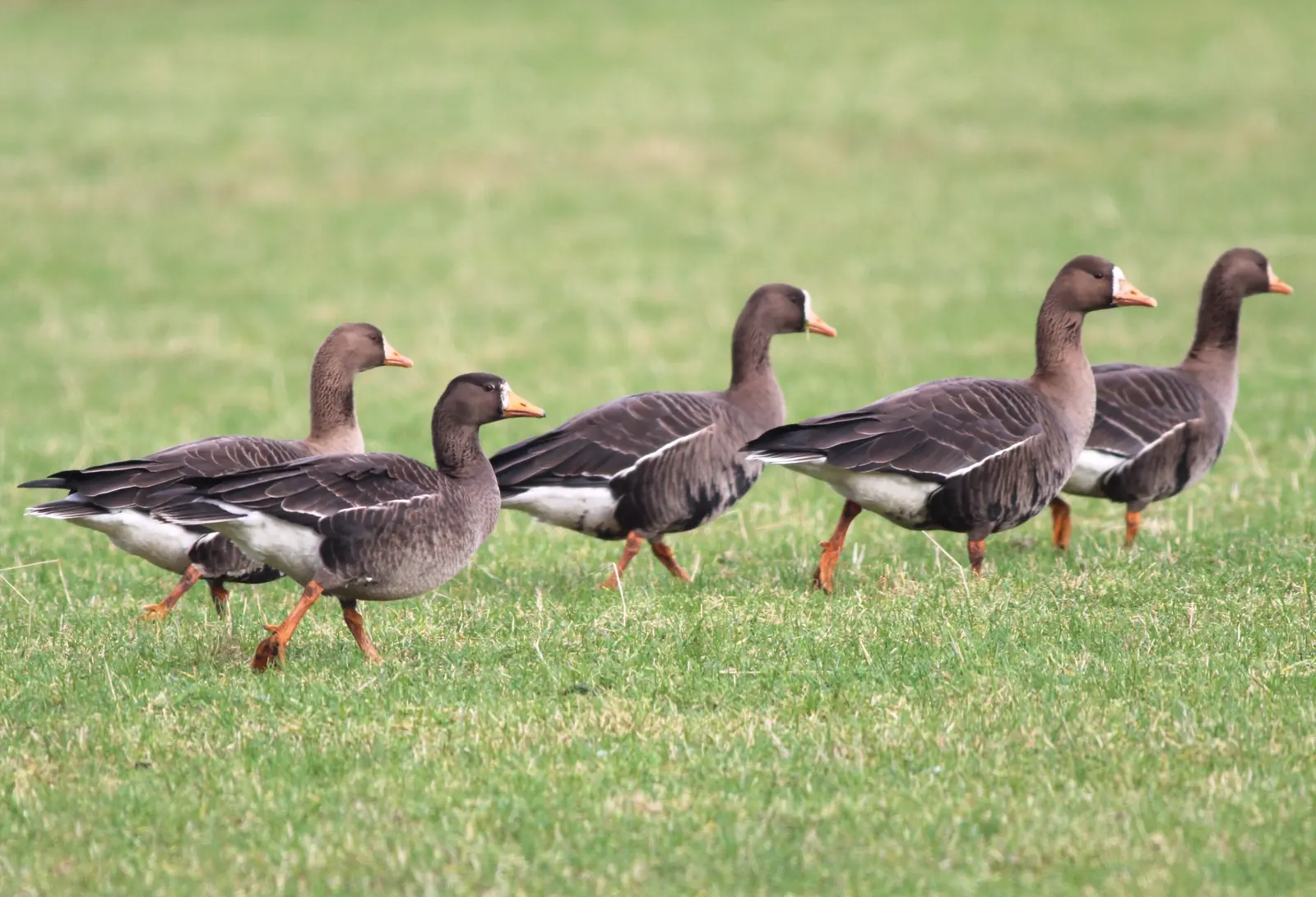
White-fronted geese are larger and browner, with a white blaze at the base of the bill and black bars across the belly. They are much scarcer. The whole Greenland population was estimated at just over 18,000 birds in 2023, about half its late 1990s peak. Islay remains one of its most important wintering sites.
White-fronts tend to feed in smaller family groups, often on wetter fields and near lochs. Seeing them well usually takes patience rather than luck.
Barnacle flocks sometimes hold the odd pink-footed, brent or Canada goose. Occasional rarities from North America also turn up, so keen birders tend to scan big flocks carefully.
The first geese usually arrive in late September. Numbers build quickly through October, and big arrivals can follow northerly winds. Most birds stay until April, when they head back to Greenland to breed.
Geese need every hour of feeding in winter, and each disturbance costs them energy. A car makes an excellent hide, so stay inside where you can. Keep voices low, switch the engine off and avoid slamming doors.
Almost all goose fields are private working farmland. Please watch from the road and never walk towards a flock. If the birds lift their heads and start to walk away, you are too close.
So many geese can damage grazing and crops, which matters on an island where farming is central to the community. NatureScot works with farmers under a long-running goose management scheme. This aims to reduce crop damage while protecting the scarcer white-fronted geese.
Avian influenza is a continuing concern for wild birds in Scotland. The risk to the public is very low, but do not touch sick or dead birds. Report them to the Defra helpline on 03459 33 55 77 or through the GOV.UK online form.
Midwinter on Islay brings short days, but by February the balance begins to shift. The geese are still here in good numbers, and the lengthening light gives you more time to enjoy them.

Daylight grows noticeably through the month. In Port Charlotte, sunrise moves from about 8.20am to about 7.20am, and sunset from around 5pm to nearly 6pm. That is up to three and a half hours more light than at the winter solstice.
The weather is the trade-off. February can bring gales, rain and the occasional crisp, still day. Plan a flexible itinerary, and keep a few indoor options for wild afternoons. The Islay Nature Centre in Port Charlotte usually opens from April, so it is unlikely to be open during a February visit.
Planning a February wildlife break?
Check dates and pricesGeese may be the headline, but Islay rewards visitors all year. Sightings always depend on season, weather and patience, so treat the following as possibilities rather than promises.
Golden eagles, hen harriers, peregrines and buzzards all breed on Islay. White-tailed eagles are now regularly reported too. Barn owls hunt at dusk, and short-eared owls appear over moorland in good vole years.
Islay is a Scottish stronghold for this red-billed crow. Look for small, noisy groups feeding on short turf in the west, particularly in dune areas such as Ardnave and Machir Bay.
Sheltered sea lochs, especially Loch Indaal, draw divers, grebes and sea ducks in winter. Whooper swans and wigeon use the lochs and wet fields.
Corncrakes return in spring and are far easier to hear than to see. Lapwings, snipe and redshank breed on wet grassland, including at Loch Gruinart.
Guillemots, razorbills, kittiwakes, fulmars and black guillemots nest around the coast. Puffins are very scarce here, so Islay is not the place to plan a puffin trip.
Otters feed along quiet shores and river mouths, and are best looked for early or late in the day. Grey and common seals haul out on rocks. Red deer live on the hills, and brown hares are often seen around Loch Gorm at dusk.


These are well-known, publicly accessible places. Check the organisers' own pages before you go, as facilities and access can change.
North-west of Bridgend · Reserve open at all times · Visitor centre and toilets 10am to 5pm
A mix of sea loch, flooded fields, farmland and moorland managed partly for geese and breeding waders. There are hides, a woodland trail and a moorland trail. Dogs must be under close control, livestock graze year-round and only assistance dogs may enter the hides. RSPB Loch Gruinart reserve page.
West of Port Ellen · Small car park · No toilets on site
Dramatic sea cliffs and moorland at the southern tip of the island. Golden eagles are resident, choughs feed on the grassland and twite flock here in winter. Keep dogs on a short lead from 1 April to 15 August and wherever livestock are present. RSPB The Oa reserve page.
Right on Rosgorm's doorstep · Shore road with lay-bys
The Scottish Ornithologists' Club describes Loch Indaal as one of the most accessible good birding spots in the country. Scan from the village shore at Port Charlotte, or drive the road towards Bruichladdich and Bridgend and stop in lay-bys. In winter, check the rocks by the shore at Bruichladdich for purple sandpipers, which feed among the seaweed at the water's edge.

North-west Rhinns · Dunes, beaches and a freshwater loch
Dune grassland here is good for choughs, and Ardnave Loch attracts wildfowl, including the odd transatlantic rarity. Machir Bay is a fine place for a bracing winter beach walk. Please respect livestock and keep to paths across farmland.
A short walk from Rosgorm · Seasonal, usually April to October
Run by the Islay Natural History Trust, the centre has displays, a library and local wildlife records. It is a good first stop for recent sightings and advice on a spring or autumn visit. Islay Nature Centre opening times.
Ferry from Port Askaig to Feolin · Most sailings need no booking
Jura sits just across the Sound of Islay and makes a memorable day trip. It is one of the wildest islands in the Hebrides, with several thousand red deer roaming its hills and glens. Deer often far outnumber people, and you may see them grazing close to the road.
Otters live along Jura's long, quiet coastline, especially near burn mouths and sheltered bays. They are most active around dawn and dusk, and they are never easy to spot. Scan the seaweed line slowly and watch for a head or a curving back in the water. Golden eagles and white-tailed eagles are also seen over the island. In the autumn stalking season, check local estate advice before walking on the hills. Islay to Jura ferry timetable (PDF).
A local guide knows where the birds have been feeding that week, and can save you hours of searching. Both of these Islay-based guides offer birdwatching and wildlife trips. Contact them directly to check availability and what each trip includes.
Guided wildlife trips across the island, including a winter goose tour, with small groups.
islayencounters.co.uk
07930 054840
info@islayencounters.co.uk
Bespoke birdwatching and wildlife tours through the year, from winter geese to summer corncrakes.
islayoutdoors.com
01496 850643 or 07985 403537
dj@islayoutdoors.com
Every season has something to offer. This summary reflects typical patterns, and timings shift from year to year.
| Months | What you may see |
|---|---|
| October to November | Geese arriving in large numbers. Whooper swans and wintering ducks return. Autumn migrants along the west coast. |
| December to February | Settled goose flocks, divers and grebes on Loch Indaal, purple sandpipers, raptors over open country. Golden eagle display from February. |
| March to April | Geese gathering before departure in April. Breeding waders displaying. Spring wader passage begins. |
| May to July | Corncrakes calling, seabirds on the cliffs, breeding waders with chicks. Keep dogs on a lead near nesting birds. |
| August to September | Wader passage on beaches and mudflats. Choughs feeding in family groups. First geese from late September. |

CalMac ferries sail from Kennacraig on the Kintyre peninsula, and the crossing to Port Askaig takes around two hours. Port Ellen ferry terminal closed on 2 June 2026 for redevelopment and is expected to stay closed until 2029. During this period, all Islay sailings use Port Askaig.
Advance booking is required for all passengers and vehicles. Book as soon as your dates are confirmed, particularly with a car. The winter timetable for 2026–27 runs from 19 October to 25 March. Winter sailings can be disrupted by weather, so check the CalMac route page before you travel. Upgrade works at Port Askaig may also cause delays.
Loganair operates daily flights between Glasgow and Islay Airport. Flights are small and can also be affected by weather. See Loganair's Glasgow to Islay page.
A car makes it far easier to reach the reserves and lay-bys, and it doubles as a hide. Many roads are single-track with passing places. Allow time for slow driving, livestock and the temptation to stop.
Travel disruption happens on island holidays. We recommend travel insurance that covers cancellation and disruption.
Rosgorm is our fully renovated traditional cottage on Main Street in Port Charlotte. It sits on the western shore of Loch Indaal, so some of Islay's best winter birding starts a few minutes' walk from the door.

Three double bedrooms sleep up to six, which suits a couple, a family or a small group of friends sharing a telescope. Fast Wi-Fi helps with checking ferry updates, weather forecasts and sightings. The enclosed garden is handy if you bring a dog, and well-behaved pets are welcome by prior arrangement.
All bedrooms and bathrooms are upstairs, and there are internal steps. The ground floor has a cloakroom with a toilet. Please get in touch if you would like to talk through the layout before booking.
The cottage is available for short breaks of three nights or more and for weekly stays. Explore the cottage and our photo gallery, or read more about Port Charlotte and Islay.
Stay in Port Charlotte for your Islay wildlife break
Check dates and pricesGreenland barnacle and white-fronted geese start arriving in late September and October. Most stay through the winter and leave for Greenland in April.
RSPB Loch Gruinart is the best-known place, with hides and a visitor centre. Flocks also feed on farmland around Loch Indaal and the Rhinns, and many can be watched from roadside lay-bys without leaving the car.
February can be rewarding. The wintering geese are still present, Loch Indaal holds divers, grebes and sea ducks, and golden eagles begin their display flights. Days are lengthening, but the weather is changeable and ferries can be disrupted, so plan some flexibility.
Yes, with care. Keep dogs on a short lead near livestock, feeding geese and shorebirds, and on moorland, grassland and shores during the breeding season from April to July. RSPB reserves have their own rules, and dogs are not allowed in the Loch Gruinart hides except assistance dogs.
A car makes it much easier to reach the reserves and lay-bys, and it doubles as a hide when watching geese. Book vehicle space on the CalMac ferry well ahead.
These organisations publish authoritative, up-to-date information. We checked each source on the date shown.
Last reviewed . Seasonal facts, opening times and travel details can change. Please check with the organisations above before you travel. Wildlife sightings are never guaranteed.
Book Rosgorm directly for a winter goose break, a spring wildlife trip or a family holiday by the sea. Rates vary through the year, so check your dates for current prices.
Check availability and pricesQuestions first? Email rhinnsretreats@gmail.com